|
A month ago, when political unrest in Bahrain began in earnest, I called “the drama in Manama” a “sideshow” and insisted that the real action was brewing in Libya. Partly, I was right: Libya is now the scene of a civil war and international military intervention. However, my other assumption at the time is now increasingly unlikely. I had predicted that Bahrain’s minority Sunni royal family, with strong local and international backing, would reach a deal with the kingdom’s disenfranchised Shia majority to establish a constitutional monarchy.
What I didn’t anticipate was the astonishing lack of restraint on all sides, particularly the government’s. It is true that Crown Prince Salman bin Hamad Al-Khalifa has made a lot of the right noises. Yet the hard-line Prime Minister Khalifa bin Salman Al-Khalifa seems to have been overseeing a series of remarkable miscalculations that have escalated the conflict rapidly so that it may become unmanageable.
The opposition too did not distinguish itself, resisting offers for dialogue and apparently also looking for every opportunity to escalate. The point of no return looms, and this is ominous for the Gulf region. What began as a somewhat nonsectarian pro-democracy movement has degenerated into a sectarian proxy confrontation between Saudi Arabia and other Sunni regional powers on the one side, and Shia opposition groups increasingly aligned with Iran on the other.
The greatest blame lies with Bahrain’s government forces. Their disproportionate, indeed outrageous use of deadly force, targeting even medical services, has shown the absence of any appreciation for the inevitable consequences of their actions. The main Shia opposition group, Al-Wefaq, also deserves criticism for refusing to enter into discussions with the regime. It is being outbid by the much more extreme Al-Haq of Hassan Mushaima, which bears the hallmarks of an organization that might end up leading a Shia armed struggle. With the intervention of ground troops from Saudi Arabia, the United Arab Emirates, Qatar and Oman, and naval forces from Kuwait, the Sunni-led governments of the Gulf Cooperation Council have rallied around the Khalifa family, further deepening the sectarian character of the conflict.
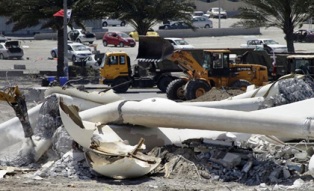
The irony is that the conflict was entirely avoidable. Simple steps such as constitutional reforms in Bahrain; the replacement of the hard-line prime minister; the reversal of inequities, particularly with regard to land ownership; and other conciliatory measures would surely have prevented this level of deterioration. However, the government’s overreaction has reached near-hysterical proportions. For example, the unbelievable demolition of the monument at the Pearl roundabout, Manama’s primary landmark, hence the center of the demonstrations; the wanton unleashing of armed street gangs; and the inexplicable arrest of the liberal reformer Ebrahim Sharif of the Al-Waad party. (I spoke at the nonsectarian group’s Manama headquarters three years ago, and the idea that they are dangerous radicals is preposterous.)
Such measures, combined with the intervention of what are perceived to be Sunni sectarian forces from the GCC, described as a “foreign occupation” by the Shia opposition, have produced an exceptionally dangerous environment of sectarian hostility, which has powerful regional implications. The GCC treaty allows for such intervention, and facilitating this is probably the real reason why Bahrain’s causeway with Saudi Arabia was constructed. But Sunnis and Shia throughout the region are taking sides in a dramatic way, portending potential sectarian tensions or even confrontation in many other countries.
There’s a broader international dimension as well. Iran has a long-standing, if presently downplayed, territorial claim on the island of Bahrain, and the US Fifth Fleet is based in the kingdom. Therefore, the long-term fortunes of the United States, the preeminent power in the Middle East, and its would-be rival Iran are also very much in play. If the situation continues to deteriorate, it is easy to imagine Iran and others beginning to arm more radical Shia elements of the Bahraini population, provoking a full-blown sectarian civil war.
It may not be too late for Bahrain to move toward constitutional and economic reforms that can avert a descent into protracted sectarian conflict, but it will have to do so quickly. Unfortunately, there are no signs that this is imminent. With both radical and reasonable opposition figures in jail; the Pearl monument in ruins, representing the shattered unity of the kingdom; GCC forces and marauding street gangs enforcing “order” with shocking brutality; and no obvious strategy on the part of the government to move away from conflict and toward constitutional monarchy, the drama in Manama is no longer a sideshow at all. It has every potential of becoming a defining, and an extremely damaging, regional and sectarian flashpoint.
Hussein Ibish is a senior research fellow at the American Task Force on Palestine and blogs at www.Ibishblog.com.
|