|
By Lauren Williams
BEIRUT: Syrian opposition fighters poured cold water on efforts to revive a fledgling U.N.-backed peace plan Monday, with Free Army leaders saying they would no longer commit to a faltering cease-fire, and others announcing a coordinated military front for operations against Syrian government forces. The pledges coincided with reports of an apparent surge in attacks against government forces over the weekend.
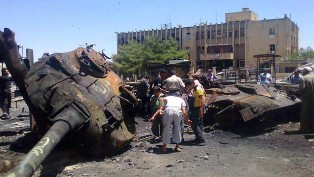
The Britain-based Syrian Observatory for Human Rights said at least 80 Syrian government soldiers had been killed in attacks by opposition fighters in Deraa, Idlib, Homs, Deir al-Zour and around Damascus in two days.
“We have decided to end our commitment to this [plan] and starting from that date [Friday] we began defending our people,” Major Sami al-Kurdi, a spokesman for the rebel military council, told Reuters, referring to a Friday deadline they set for President Bashar Assad to end the violence or face consequences.
That deadline, issued in the wake of reports of a brutal massacre of over 108 people, half of them children, apparently perpetrated by Assad’s military and paramilitary forces in the central city of Houla on May 25, passed with no apparent ease in violence.
In a speech Sunday, Assad denied his forces had been responsible for the killings and vowed to crush a revolt he blamed on foreign-backed extremists.
The massacre drew international condemnation and dashed fading hopes for the plan, drafted by U.N. envoy Kofi Annan and aimed at nurturing conditions for a political solution to the crisis, but prompted no definitive response in terms of further sanctions or threat of intervention.
Rami Abdul-Rahman, who heads the Observatory, said rebel forces had told him over 100 Syrian soldiers had been killed in fighting Saturday and Sunday, adding that he had verified the deaths of 80 Syrian soldiers through medical sources. He said 57 soldiers had been killed Saturday alone.
“The majority were killed in Douma, near Damascus, where 16 soldiers were killed and at least three tanks destroyed,” Abdul-Rahman told The Daily Star.
Speaking from inside Syria, rebel leader Kurdi told Reuters that the attacks were “part of our plan and of what we have said we will do to protect civilians.”
He said the fighters had resumed defensive attacks but “would not launch attacks on camps or big posts.”
General Mustafa al-Sheikh, a former army commander, told Reuters by telephone from Turkey that the Annan plan had been “stillborn.”
Also claiming international initiatives had failed, opposition activists in Turkey announced the formation of the Syrian Rebel Front aimed at unifying the command of disparate militant opposition groups inside the country.
In a statement, the Front said international efforts to end the violence had failed and called on “the sons of Muslim nations to support their battle with money and arms.”
In a statement, organizers said up to 12,000 fighters were ready to mobilize in response to Assad’s “scorched earth policy.”
Speaking ahead of the announcement, Muslim Brotherhood-aligned member of the Syrian National Council Mohammad Sarmini told The Daily Star that the Front’s purpose was to “arm Islamist fighters.”
“The main purpose is to organize financial and military support for Islamists fighting on the ground,” he said, adding that the Front would coordinate with the SNC and FSA forces.
But underscoring divisions within the opposition, the SNC, which had previously formed a military bureau in an attempt to similarly unify fighting groups on the ground, distanced itself from the group.
“The Syrian National Council confirms it does not endorse the recently announced coalition [Military Coalition for Syrian Revolutionaries Front] and declares it has no relationship with it, despite being attended by a few SNC Executive Committee members in their individual capacity,” Georges Sabra, spokesman for the SNC said in a statement.
Arab and Western states have been reluctant to supply anti-regime fighters, partly because of their lack of cohesion, and also for fear of igniting a broader sectarian conflict.
Ahead of his briefing to the U.N. Security Council and General Assembly in New York Thursday, Annan said major powers must ensure that the six-point plan is implemented by both sides, but for now did not favor expanding the monitoring mission as some opposition groups had called for, his spokesman said.
He will continue to press his six-point plan as “the only option on the table,” said spokesman Ahmad Fawzi.
“Many people like you have questioned whether the six-point plan has failed – whether it is the end, whether it is dead. They’ve written the obituary already. But we will continue to pursue the plan because it is the only option on the table at the moment,” Fawzi told Reuters Television in Geneva.
“As Mr. Annan told Mr. Assad and other interlocutors, the plan is not being implemented as it must be by either side. The time may have come to review the situation, and the international community has to decide what measures it can take to ensure implementation of the plan,” Fawzi said.
U.N. Secretary-General Ban Ki-moon, in Saudi Arabia Monday, said the plan remained central to resolving the Syrian conflict, but reiterated that there was no discussion of military options for Syria.
Ban urged Assad’s government to stop the violence immediately “in the name of humanity” and to start a political dialogue with his foes.
Meanwhile, Arab League chief Nabil Elaraby will travel to New York this week to meet with Ban and the ambassadors from the five permanent members of the Security Council, namely the United States, Russia, China, Britain and France, to discuss the Syrian crisis.
Arab ministers at a meeting in Doha Saturday urged the U.N. to refer Annan’s peace plan for Syria to Chapter VII, without explicitly calling for military action.
Chapter VII outlines action the U.N. Security Council might take, including military force, in response to threats to international peace, breaches of the peace and acts of aggression.
Russia, alongside China, is opposed to military intervention in Syria and has resisted strong U.N. Security Council action against its Soviet-era ally and says it remains committed to implementation of the plan.
|